
How to Manage Intrusive Thoughts (Without Making Them Worse)
Intrusive thoughts management starts with knowing that intrusive thoughts are unwanted mental events, not evidence of intent or character. They can feel disturbing and hard to shake, which is why they grab your attention so fast.
When they show up, many people try to push them away or get reassurance that they don’t mean anything. That response can intensify the spiral and leave you more anxious or mentally drained.
There are clearer ways to respond. Here’s how to manage intrusive thoughts without making them worse, and when therapy may be the right next step.
Why intrusive thoughts feel so disturbing

Intrusive thoughts can feel disturbing because they often hit the areas of life that matter most to you. They may center on safety, health, relationships, morality, or the fear of doing something out of character.
They also tend to hit fast. A thought flashes through your mind, your body reacts, and your attention locks onto it before you’ve had time to slow down. That speed is part of what makes the experience feel so convincing in the moment.
They’re also far more common than people think. In one international study, 93.6% of participants reported at least one intrusive thought in the previous three months.
Stress can make that reaction stronger. When your system is already strained, anxious, or mentally tired, intrusive thoughts can feel louder and harder to shake. That’s part of what makes intrusive thoughts management so important.
How to respond when intrusive thoughts show up
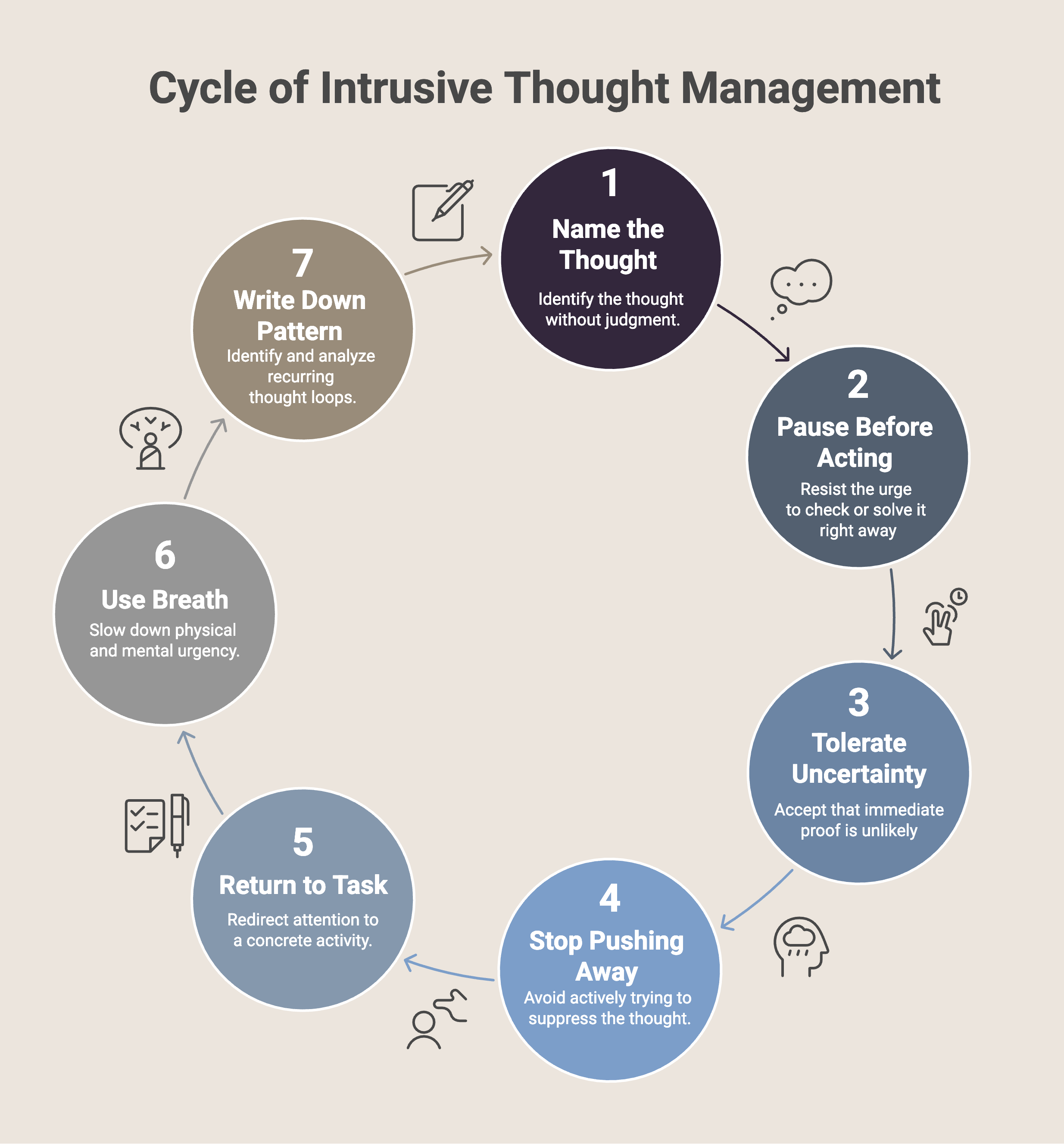
Good intrusive thoughts management starts with what you do next. When a thought feels disturbing, the urge is often to solve it right away. That rush for relief is what keeps the cycle going.
1. Name the thought without treating it as truth
Start with simple language.
Try saying, “I’m having an intrusive thought that…” That small shift helps you notice what is happening without collapsing into it.
2. Pause before checking or seeking reassurance
You may want to check your memory, your reaction, your body, or another person’s opinion.
Pause there. Reassurance can calm you for a moment, but it also teaches your mind that the thought needs an emergency response.
3. Let the uncertainty stay for a moment
Intrusive thoughts often push for certainty. You may want immediate proof that the thought means nothing and will not come back.
That relief rarely lasts. This is why exposure and response prevention help people face distress without doing the behavior that briefly lowers it.
4. Stop trying to push the thought away
Trying to force the thought out often keeps your attention locked on it.
You start monitoring whether it is gone, whether it is back, and what that means. That turns one thought into a longer spiral.
5. Return to one task in front of you
Bring your attention back to one concrete thing.
Finish the email. Wash the dish. Keep walking. Read the next line. The goal is to place your attention somewhere useful.
6. Use your breath to slow the spiral
A slower exhale can help bring down the physical rush that makes the thought feel more urgent.
It won’t erase the thought, but it can help you respond with more choice and less panic.
7. Write down the pattern you keep repeating
If the same loop keeps showing up, write down four parts: what triggered it, the intrusive thought, what you feared it meant, and what you did next.
That can help you spot the pattern more clearly. You may start noticing the same pull toward checking, avoidance, or reassurance before the spiral gets bigger.
Once the cycle is easier to see, it gets easier to interrupt. If it keeps taking over, find support that fits what you’re dealing with.
When intrusive thoughts may be more serious than they seem

Intrusive thoughts need closer attention when they stop feeling occasional and start taking up too much space in your day.
You may notice yourself:
replaying moments
avoiding certain places
checking your reactions
asking for reassurance more often than you want to
At that point, the issue isn’t only the thought itself. It’s the cycle that keeps pulling your time, focus, and energy away from everything else.
It also matters when the distress keeps rising instead of settling.
If intrusive thoughts are making it harder to function, trust yourself, or stay present in daily life, support may be worth considering sooner rather than later.
Begin intrusive thoughts management with the right support
If intrusive thoughts management keeps breaking down in the same places, therapy can help you understand the pattern and respond with more clarity. That may include CBT, ERP, or trauma-focused work, depending on what’s driving the cycle.
CBT EMDR Therapy of Manhattan offers support in person in Manhattan and virtually across New York. With the right approach, it gets easier to step out of fear, checking, and reassurance and respond more steadily.
If the loop keeps taking over, you don’t have to keep sorting through it on your own. Schedule a free consultation to take the next step.
FAQs
What causes intrusive thoughts?
Intrusive thoughts can show up during stress, anxiety, trauma, or OCD-related patterns. They often get louder when your mind is already on high alert.
Do intrusive thoughts mean anything about me?
No. Intrusive thoughts are unwanted mental events. They can feel disturbing precisely because they clash with your values, not because they reveal your character.
Why do intrusive thoughts keep coming back?
They often come back because the mind starts treating them like a threat that needs an answer. Checking, avoiding, or seeking reassurance can keep that cycle going.
When are intrusive thoughts a sign of OCD, anxiety, or trauma?
It may point to a larger issue when the thoughts are persistent, highly distressing, tied to rituals or avoidance, or starting to interfere with daily life. The thought itself matters less than the pattern forming around it.
What type of therapy helps with intrusive thoughts?
CBT and ERP are often helpful when intrusive thoughts are tied to OCD or anxiety. Trauma-focused work may also help when unresolved experiences are part of the cycle.