
What Is ERP Therapy for OCD and How It Breaks the Cycle
Living with obsessive thoughts and compulsive behaviors can feel like being caught in the same sequence each day. A distressing thought appears, anxiety rises, and rituals take over just to create a moment of relief. Even when you recognize the pattern, interrupting it can feel out of reach.
That cycle is exhausting. Hours can disappear into checking, washing, replaying thoughts, or trying to feel certain again. Relief fades quickly, and the mind stays alert for the next threat, leaving many people feeling worn down and discouraged.
If you’re asking what is ERP therapy for OCD is, it’s usually because what you’ve tried so far hasn’t changed this pattern. Learning how this approach works can help explain why the cycle continues and what actually helps it loosen.
As clinicians who work closely with people struggling with these patterns, we see how targeted, structured treatment supports real change.
This article explains how exposure and response prevention works and why it remains the most effective approach for breaking the cycle safely and gradually.
What Is ERP Treatment For OCD?

Obsessive–compulsive symptoms are not about preference or personality. They involve intrusive thoughts that trigger anxiety, followed by behaviors meant to bring relief. While those behaviors help briefly, they also train the brain to stay on alert.
So, what is ERP therapy for OCD? Exposure and Response Prevention is a structured treatment designed to interrupt this pattern. It helps the nervous system learn that anxiety can rise and fall without relying on rituals to feel safe.
ERP works through two coordinated steps:
Exposure
Exposure involves intentionally approaching situations or thoughts that trigger anxiety instead of avoiding them. This may include real-life experiences, such as touching something that feels unsafe, or imagined scenarios that bring up distressing fears. The focus is on staying present long enough for anxiety to shift on its own.
Response Prevention
Response prevention means not doing the actions that usually follow anxiety. This includes things like checking, washing, repeating thoughts, or asking for reassurance. When these behaviors are paused, the brain begins to learn that nothing bad happens when the ritual is skipped.
Research using standardized measures like the Yale-Brown Obsessive Compulsive Scale shows meaningful symptom reduction when this approach is practiced consistently.
Change happens by learning to tolerate uncertainty, not by trying to feel certain or reassured all the time.
How ERP Therapy for OCD Breaks the Cycle

ERP works by changing what happens after anxiety shows up. Instead of reacting in the usual way, you practice responding differently, with guidance and support. This is how the cycle begins to weaken.
1. Build Your Fear Hierarchy
You and your therapist start by listing situations or thoughts that trigger anxiety. These are placed in order from less difficult to more difficult, based on how uncomfortable they feel.
For example, touching something that feels dirty may feel manageable, while leaving the house without checking the locks may feel much harder. This list helps keep the process gradual and safe.
2. Begin Exposure
Exposure begins with items that feel more manageable. You intentionally face a trigger instead of avoiding it.
This might mean holding something that feels unsafe without cleaning it, or allowing a distressing thought to be present without trying to get rid of it. The goal is to stay with the discomfort long enough to notice that it changes.
3. Practice Response Prevention
As anxiety rises, the urge to perform a ritual often follows. Response prevention means choosing not to act on that urge.
This includes behaviors like washing, checking, or searching for reassurance, as well as mental habits like reviewing thoughts or trying to feel certain. Skipping these responses prevents the brief relief that keeps the cycle going.
4. Watch Anxiety Shift
Anxiety often increases at first, then gradually decreases on its own. Nothing needs to be done to make it stop.
With repeated practice, the brain begins to recognize that feared outcomes do not happen. Anxiety becomes easier to tolerate and less controlling over time.
Some people find certain steps harder because of past experiences or trauma. In those cases, pacing can be adjusted so the work feels steady rather than overwhelming.
Proven Benefits of ERP Therapy for OCD
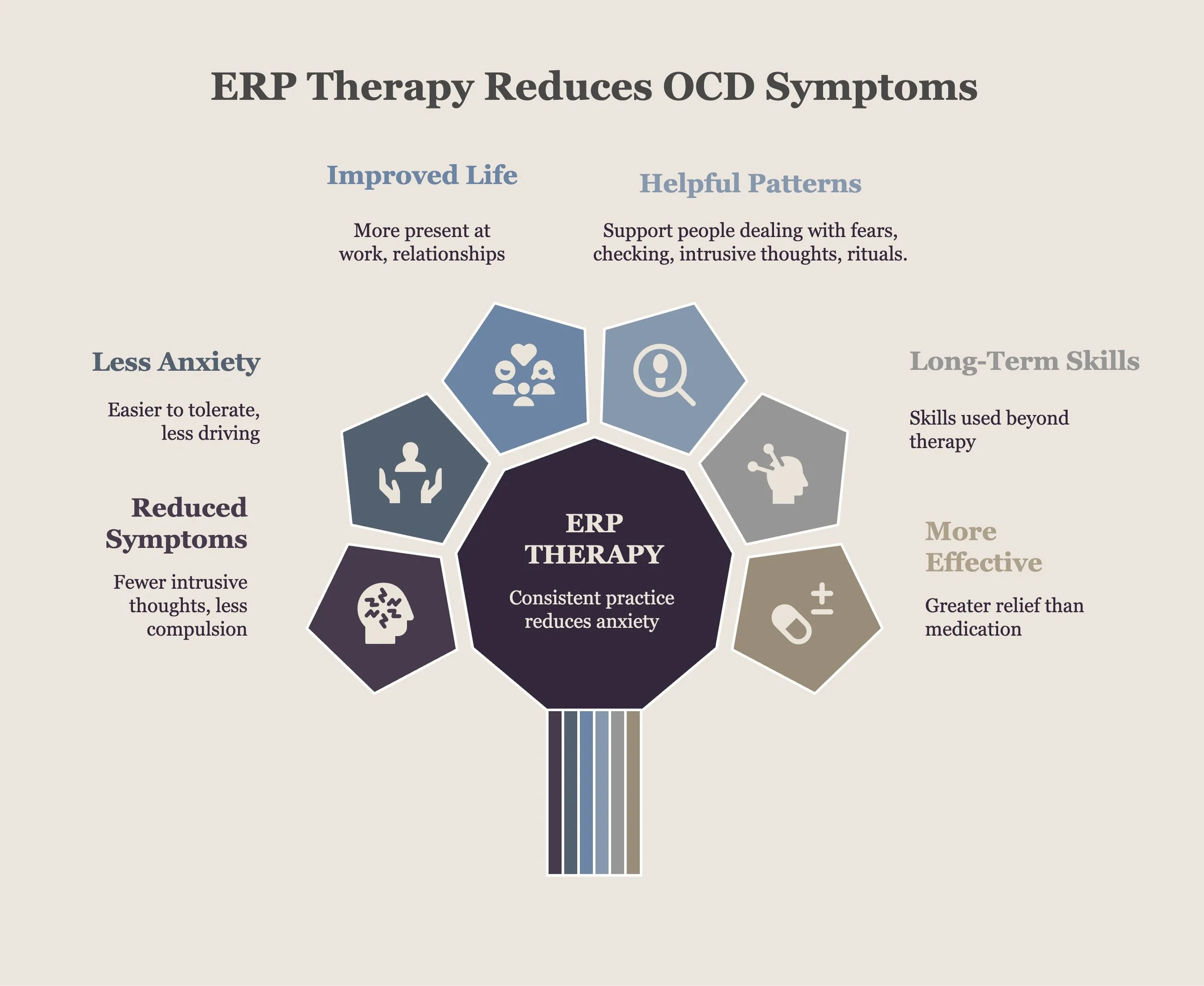
ERP is widely used because it helps people change how anxiety controls their lives. Rather than offering temporary relief, it supports lasting shifts in how thoughts, fear, and behavior interact. When practiced consistently, several benefits tend to show up:
Reduced symptoms: Many people experience fewer intrusive thoughts and spend much less time on compulsive behaviors when ERP is practiced consistently.
Less anxiety overall: Anxiety may still appear, but it becomes easier to tolerate and no longer drives daily decisions or routines.
Improved daily life: As rituals decrease, people often feel more present at work, in relationships, and during everyday activities.
Helpful across different patterns: ERP can support people dealing with contamination fears, checking intrusive thoughts, and mental rituals.
Long-term skills: ERP teaches skills that can be used beyond therapy, helping many people maintain progress after treatment ends.
Often more effective than medication alone: Some people find ERP brings greater relief because it changes how anxiety is handled, not just how symptoms are managed.
ERP Therapy vs. Other OCD Treatments

There are several ways OCD is treated, and each has a role. What makes ERP different is how directly it addresses the behaviors that keep the cycle going.
Below is a simple comparison to help clarify how it differs from other options:
ERP Therapy vs. Medication
Medication can reduce symptoms for some people by lowering anxiety levels. This can make thoughts feel less intense, but it does not teach new ways of responding when anxiety shows up.
ERP focuses on changing behavior patterns so anxiety becomes easier to handle over time. Some people use both together, while others find ERP helpful even when medication alone was not enough.
ERP Therapy vs. General Talk Therapy
Talk therapy can help people understand their feelings and experiences. This can be supportive, but it often does not change the behaviors that maintain OCD.
ERP works differently by focusing on what happens after anxiety appears. By practicing new responses, people learn through experience that fear does not need to be managed with rituals.
ERP Therapy vs. ACT or Mindfulness Approaches
Acceptance and mindfulness-based therapies help people relate differently to intrusive thoughts. These approaches can be especially helpful for learning not to fight thoughts or judge them.
ERP adds an action-based component by directly reducing compulsive behaviors. Some people benefit from using both together, with acceptance skills supporting the exposure work.
Living Beyond the OCD Cycle
Living with OCD can make it feel like anxiety is always present in the background, shaping decisions and routines in quiet but powerful ways. Even when you recognize the pattern, changing it can feel harder than expected.
Understanding what is ERP therapy for OCD can bring clarity and relief. It offers a way to respond differently to anxiety, so it no longer has to dictate your day. With consistent, supported practice, many people find that fear becomes easier to tolerate and less disruptive over time.
If this resonates with your experience and you’re considering support, contact us today to begin that conversation.
Frequently Asked Questions
Does ERP therapy make OCD worse at first?
ERP can feel uncomfortable at the beginning because it involves facing fears instead of avoiding them. This does not mean symptoms are getting worse. Anxiety usually rises briefly, then settles on its own. With repetition, most people notice anxiety becomes less intense and easier to manage.
How long does ERP therapy usually take to work?
ERP therapy length varies by person. Some notice changes within weeks, while others need several months. Progress depends on consistency, severity of symptoms, and how often skills are practiced. Improvement is usually gradual, not sudden, and builds as the brain learns new responses.
Can ERP therapy help with intrusive thoughts only?
Yes. ERP is effective for intrusive thoughts even when there are no visible rituals. Treatment focuses on mental habits like rumination, reassurance-seeking, or reviewing thoughts. By learning not to respond to these urges, intrusive thoughts often become less distressing and less frequent.
Do I have to face my biggest fears right away in ERP?
No. ERP is done gradually. Treatment starts with situations that feel more manageable and builds from there. The pace is planned carefully so exposures feel challenging but not overwhelming. Facing larger fears usually happens later, once skills and confidence have grown.
Is ERP therapy safe if OCD is linked to past trauma?
ERP can be adapted when trauma is part of someone’s history. Pacing and structure are adjusted to avoid overwhelm. When done carefully, ERP helps reduce compulsions without forcing exposure to traumatic memories, allowing progress to feel steady rather than destabilizing.