
Cognitive behavioral therapy (CBT) can help adults address trauma-related difficulties, including posttraumatic stress disorder (PTSD). In CBT for trauma and PTSD, adults examine trauma-related beliefs, practice approaching safe reminders they’ve avoided, or do both, depending on the treatment. Between sessions, they apply what they learn and review the results with their therapist.
Cognitive processing therapy (CPT) uses questions and worksheets to examine beliefs such as self-blame. Prolonged exposure (PE) includes recounting trauma memories and gradually approaching safe reminders.
CBT / EMDR Therapy of Manhattan offers trauma therapy shaped around your symptoms and treatment preferences, with in-person appointments in Manhattan and online sessions across New York.
What your therapist asks at the first appointment

Your therapist asks what brought you in and what symptoms you’re having. They also ask how those symptoms affect your sleep, work, relationships, and daily life, along with past treatment, health, substance use, support, and safety.
You can begin with a single sentence, such as “I avoid the subway since the assault.” Your therapist can explain how much detail is needed for the assessment. Describing nightmares, unwanted memories, feeling on guard, or feeling disconnected helps your therapist see the pattern.
Going through a trauma doesn’t automatically mean you have PTSD. An assessment checks for PTSD and other conditions that could explain your symptoms. Then you and your therapist identify practical changes, such as sleeping more consistently or returning to an activity you’ve been avoiding.
What adults do in trauma-focused CBT sessions
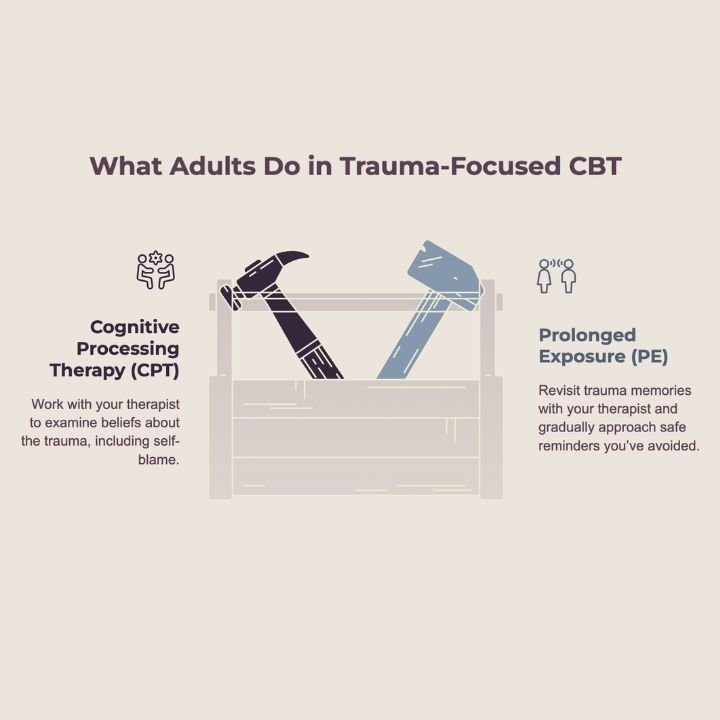
CBT for trauma in adults addresses trauma-related beliefs and avoidance. The tasks and sequence depend on the treatment. The specific model called TF-CBT was developed for children and adolescents.
CPT and PE are two well-studied trauma-focused treatments for adult PTSD. A 2022 randomized trial of 916 U.S. veterans with PTSD found meaningful symptom improvement with both treatments.
How cognitive processing therapy addresses self-blame
In CPT, you and your therapist examine the conclusions you formed about the trauma. Your therapist asks you to write down a thought such as “I should have stopped it,” then helps you examine it against what you knew and could realistically do at the time.
Over several sessions, you practice separating hindsight from the choices you actually had. This helps you assess responsibility more accurately without minimizing the harm or forcing a positive interpretation.
How prolonged exposure works with memories and safe reminders
You gradually approach trauma memories and safe situations you’ve been avoiding. In sessions, you describe the memory aloud with your therapist’s guidance—a process called imaginal exposure. Between sessions, you practice approaching safe reminders in daily life, called in vivo exposure.
After a subway assault, that could mean a planned series of trips on public transit under reasonably safe conditions. PE doesn’t involve returning to an abusive person or an unsafe place.
Do you have to describe the trauma in detail?
It depends on the treatment. PE involves repeatedly and in detail recounting the memory aloud. CPT focuses on what the event means and how it has affected you, and a detailed written account is optional. Before you begin, your therapist should explain what you’d share, how it supports treatment, and how they’ll guide you.
What you practice between CBT sessions

Between sessions, CBT for trauma and PTSD involves practicing the tasks agreed with your therapist and reviewing what happens.
In CPT, you log a situation, the belief it triggered, and the emotion that followed, then test that belief with the questions from therapy. In PE, you practice planned contact with safe reminders and listen to recordings of your imaginal exposure sessions as agreed with your therapist. Discuss a private, secure way to store recordings.
Bring back what didn’t work as well as what did. If you have difficulty completing practice, lack privacy, or experience distress you can’t manage, tell your therapist what to change before the next assignment.
How therapists track progress in CBT for PTSD

Your therapist tracks progress through standardized symptom scales, behavioral logs, and reviews of daily functioning. These help show changes in symptoms and your ability to resume activities PTSD has disrupted.
Standardized scales use consistent questions to compare symptoms across appointments. The PTSD Checklist for DSM-5, or PCL-5, is a 20-item questionnaire that measures symptom severity. Your therapist reviews the scores alongside your experiences.
Behavioral logs record between-session practice, including which safe situations you approached and what happened. In PE, these logs can show reduced avoidance even when anxiety remains. In CPT, worksheets track changes in beliefs about responsibility, trust, or danger.
Daily life can also show progress, such as sleeping more consistently, going to work, or using transportation again. When symptoms worsen or improvement stalls, you and your therapist examine barriers and adjust the plan.
Discuss trauma therapy with a Manhattan therapist
Ask which trauma-focused approach the clinician offers, what you’ll do in sessions, and how progress will be measured. You can discuss concerns about memory work or between-session practice before agreeing to a plan.
CBT / EMDR Therapy of Manhattan offers CBT, EMDR, and exposure-based therapy in Manhattan and online across New York. Schedule your free consultation to talk about the concerns you want treatment to address.
FAQs about CBT for trauma and PTSD
Can adults do trauma-focused CBT?
Yes. Adults can receive trauma-focused CBT through treatments such as CPT and PE. The term TF-CBT also names a specific model developed for children and adolescents, usually involving caregivers. If you’re searching for “TF-CBT for adults,” ask which adult treatment the therapist offers and what participation involves.
How long does trauma-focused CBT take?
Duration depends on the treatment and the person. CPT is typically 12 weekly sessions. PE typically lasts 8 to 15 sessions overall. Assessment, scheduling, and clinical adjustments change the total timeline, so treat these figures as planning references, not fixed counts.
How effective is CBT for PTSD?
CPT and PE can reduce PTSD symptoms, though individual responses vary. Both are strongly recommended treatments for adult PTSD in the 2023 VA/DoD guideline, summarized in a 2024 review. This recommendation reflects evidence supporting these specific approaches; it doesn’t mean every form of CBT is equally effective.
When might a therapist adapt or delay trauma-focused CBT?
Immediate safety needs, an acute crisis, or difficulty taking part can change the plan. Your therapist assesses what support or level of care you need. Depression, anxiety, or another condition doesn’t automatically rule out trauma-focused treatment. Planning should fit your circumstances instead of requiring you to feel calm before beginning.
Can trauma-focused CBT for PTSD be done online?
Yes. CPT and PE can be delivered by secure video with a trained therapist. The practice offers online therapy across New York. Before booking, ask which trauma-focused approach is available and how sessions, privacy, and interruptions are handled.