
CBT for trauma and PTSD (post-traumatic stress disorder) can include psychoeducation, identifying automatic thoughts, restructuring beliefs, imaginal exposure, in vivo exposure, coping skills, and between-session practice.
Examining self-blame takes a different approach than facing a situation you’ve been avoiding. In trauma therapy, you and your clinician discuss which techniques fit your symptoms and what the work involves.
How CBT changes trauma-related patterns

Cognitive behavioral therapy (CBT) looks at how thoughts, feelings, and behaviors reinforce each other after trauma. Some approaches focus on examining beliefs about what happened. Others help you gradually approach safe reminders or situations you’ve been avoiding.
For example, a reminder can set off self-blame, which may lead to guilt, shame, and pulling away from people. Avoiding the reminder can bring short-term relief, but it can also leave the belief unchallenged.
Seven CBT techniques used in trauma treatment
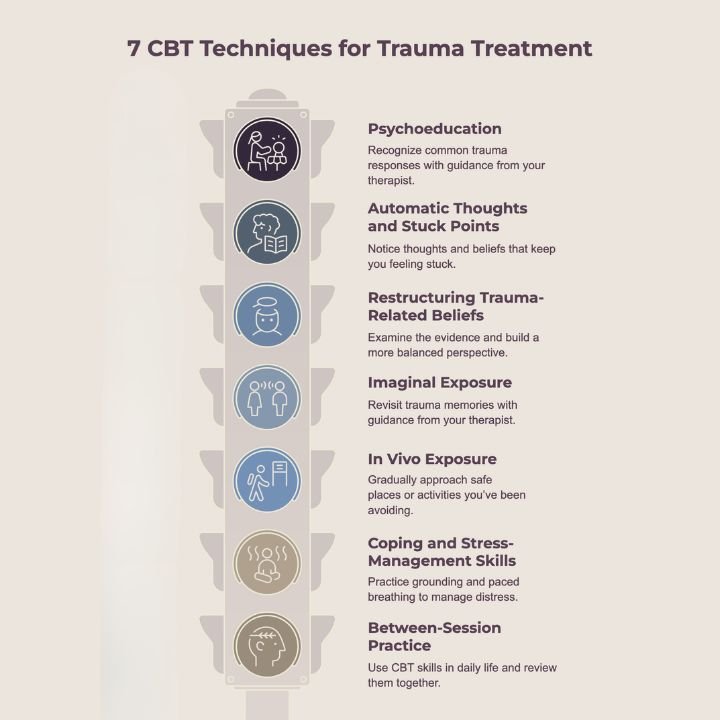
These techniques appear across trauma-focused CBT approaches. Which ones you practice depends on the treatment you and your clinician choose.
1. Understanding trauma responses through psychoeducation
Psychoeducation helps you understand common reactions to trauma. Your therapist explains why you might feel constantly on alert, avoid reminders, or have trouble sleeping.
2. Identifying automatic thoughts and stuck points
This method helps you notice thoughts that pop up quickly and feel true. In cognitive processing therapy (CPT), a stuck point is a belief about the trauma or its effects that can get in the way of recovery, such as “It was my fault” or “I can never trust anyone.”
3. Restructuring trauma-related beliefs
Restructuring means testing a belief against the evidence and building a more accurate view. Your therapist helps you separate what you knew at the time from what became clear later. That can help you reconsider self-blame while taking what happened seriously.
4. Revisiting trauma memories through imaginal exposure
Imaginal exposure involves deliberately recalling the trauma memory, often by describing it aloud with a therapist. In prolonged exposure (PE), you revisit the memory over several sessions and discuss the thoughts and feelings that come up.
5. Approaching avoided situations through in vivo exposure
In vivo exposure involves gradually approaching places or activities that are safe but that you’ve avoided since the trauma. For example, if you’ve been avoiding public transit, you might work with your therapist to plan a short trip on a familiar route.
6. Building coping and stress-management skills
Grounding and paced breathing can help you manage distress in the moment. Grounding uses your senses to bring your attention back to the present. Paced breathing slows the rhythm of your breath when you feel on edge.
7. Practicing CBT skills between sessions
Between-session practice gives you a chance to use what you’re learning in daily life. Your therapist might ask you to note when a difficult thought came up or try an exposure task you’ve agreed on.
You then review how it went at your next session.
How CBT worksheets support trauma treatment

CBT worksheets for trauma help you record what happened, what you thought and felt, and how you responded. You and your therapist can use those notes to see patterns you might miss in the moment.
Some worksheets ask you to compare evidence for and against a thought, then write a more balanced alternative. Others ask you to rate how strongly you feel an emotion or believe a thought.
In cognitive processing therapy, worksheets help you identify and question stuck points. Writing a detailed account of the trauma is optional and depends on the version of CPT you and your therapist choose.
What to expect from CBT for trauma in adults

Treatment starts with an assessment of your symptoms, past experiences, current safety, and daily functioning. You and your clinician then agree on a plan.
Sessions focus on the beliefs, memories, or situations your plan targets, with practice between appointments.
Progress can look like returning to avoided activities, responding differently to reminders, or participating more fully in relationships. Regular reviews show what is changing and what still needs attention.
When another trauma therapy may fit better

If progress stalls or the format is hard to keep up with, tell your therapist what’s getting in the way. You can review your symptoms and how treatment is going before deciding whether to adjust the plan or try another approach.
One option is eye movement desensitization and reprocessing (EMDR), a trauma-focused treatment for PTSD. During EMDR, you briefly focus on parts of a distressing memory while your therapist guides you through side-to-side eye movements or alternating taps.
Try CBT for trauma and PTSD in Manhattan
CBT / EMDR Therapy of Manhattan offers in-person appointments in Manhattan and online therapy across New York. Call (917) 935-4040 or schedule a free consultation to talk through what’s been hardest lately and ask about treatment options.
FAQs about CBT for trauma and PTSD
Can CBT treat PTSD?
Yes. The VA/DoD clinical practice guideline for PTSD recommends trauma-focused therapies for adults with PTSD, including CPT and prolonged exposure. A therapist trained in these approaches can help you decide which one fits your symptoms and goals.
How many sessions does CBT for PTSD take?
CPT often follows a 12-session plan, and prolonged exposure typically takes 8 to 15 sessions. Your course of treatment may be shorter or longer depending on the approach and how you’re responding.
What are some CBT exercises for trauma in adults?
One CBT exercise is to notice a reminder, write down the first thought it brings up, and rate how strongly you believe it. Your therapist can help you decide what to work on when you review the record together.
Can CBT for trauma make you feel worse before you feel better?
Distress can rise temporarily when you approach trauma reminders. Tell your clinician if the distress persists, you feel disconnected, or daily tasks become harder. You can talk about whether to adjust the pace or the next exercise.
Can I do CBT for trauma on my own?
You can practice skills you’ve learned in therapy, such as grounding or tracking thoughts. Work with a trained therapist to plan and pace trauma-focused exercises like revisiting a distressing memory.