
EMDR for childhood trauma involves bringing a distressing memory to mind while you follow guided eye movements, alternating taps, or sounds. You notice the thoughts, emotions, and physical sensations connected to the memory, with pauses to describe what comes up.
You don’t have to give a detailed spoken account of everything that happened. The work focuses on selected experiences and how they affect you now.
In eye movement desensitization and reprocessing (EMDR) therapy, preparation comes before memory processing, and regular check-ins help guide the next session.
Why childhood trauma can keep affecting adult life

Childhood trauma can affect how you respond to danger and shape beliefs about safety, trust, and self-worth that can persist into adulthood.
The Centers for Disease Control and Prevention explains that prolonged stress linked to adverse childhood experiences can affect brain development, attention, learning, and decision-making. The effects differ from person to person.
For example, disagreement could feel threatening, or expressing a need could bring up fear of punishment. Staying quiet could once have helped you avoid conflict, but that response can make it harder to ask for support in adult relationships.
How EMDR processes childhood trauma memories
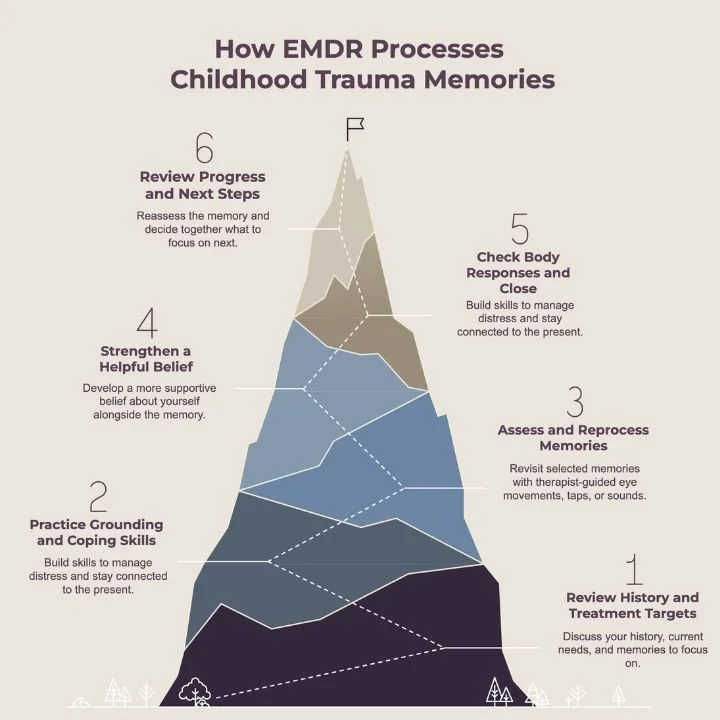
EMDR follows eight phases, grouped into six steps below. Some phases, such as preparation or memory processing, may take more than one session.
1. Review your history and identify treatment targets
A treatment target is a specific memory or experience you’ll focus on in therapy. Treatment begins with your history, what brings you in, and the support you have now. Your therapist also asks about current safety and anything that could make it hard to stay present during sessions.
2. Practice grounding and coping skills
In preparation, you learn ways to manage distress and bring your attention back to the present. One grounding technique is to notice what you can see and hear in the room. You practice skills like these and agree on a signal for pausing before memory work starts.
3. Assess and reprocess distressing memories
Before processing a memory, you and your therapist identify an image, a belief about yourself, an emotion, and any physical sensations linked to it. Then you bring aspects of the memory to mind while your therapist guides you through short sets of alternating eye movements, taps, or sounds.
Between sets, you describe what you notice so your therapist can decide what to focus on next. You don’t need to reach a specific insight or have a particular emotional response.
4. Strengthen a more helpful belief
For example, you might choose “I have choices” as an alternative to “I am powerless.” You hold the memory in mind alongside the belief you’d like to strengthen and rate how true it feels.
5. Check body responses and close the session
Your therapist asks you to notice physical sensations linked to the memory, such as a tight chest or tense shoulders. Before the session ends, they may guide you through a grounding exercise to help you return your attention to the present.
A session can end before a memory is fully processed. You and your therapist discuss what you might notice before the next appointment and what to do if distress comes up.
6. Review changes and choose next targets
At the next appointment, you discuss how things have been since your last session and reassess the memory. Changes in distress, beliefs, body sensations, and daily life help you and your therapist decide whether to keep working on the same target or choose another.
What progress with EMDR can look like

Progress can look like less distress when you recall a memory, less self-blame, or milder physical reactions to reminders. You might also return to activities you’ve been avoiding or settle more quickly after something upsetting happens.
The VA/DoD clinical practice guideline for PTSD recommends EMDR for post-traumatic stress disorder (PTSD). How much and how quickly symptoms change varies from person to person.
When childhood trauma shows up as anxiety or depression

Childhood trauma can contribute to anxiety or depression. Your therapist can help you explore whether past experiences are connected to your symptoms. Research on using EMDR to treat anxiety and depression directly is still developing.
EMDR for anxiety linked to past experiences
A current situation can set off the same fear you felt back then. EMDR can focus on a memory linked to that fear. A review of randomized trials found that EMDR reduced some anxiety symptoms, though the long-term effects need more study. Your therapist may also recommend an approach such as cognitive behavioral therapy (CBT) based on the type of anxiety you’re experiencing.
EMDR for depression linked to past experiences
Low mood, pulling away from people, and harsh thoughts about yourself can sometimes be linked to earlier experiences. A review of trials on EMDR for depression found improvements in depressive symptoms, though more research is needed on whether those benefits last.
Your therapist will ask how low mood is affecting your sleep, energy, and routines. If distressing memories are part of what’s weighing on you, memory work may be one part of the plan.
How EMDR is paced for complex childhood trauma

When childhood trauma was repeated or prolonged, you may need more time to prepare before processing memories. In one trial of adults with PTSD after childhood abuse, adding a separate course of skills training before EMDR produced no clear advantage over starting EMDR without that extra course.
Your therapist can adjust the pace if you feel detached, lose track of time in sessions, or struggle between appointments. Tell them what you’re noticing so you can decide whether to pause or change the plan.
Start EMDR for childhood trauma in Manhattan
If you’re choosing an EMDR therapist, ask what you’ll need to share and how they’ll help if a session becomes difficult.
CBT / EMDR Therapy of Manhattan offers therapy for adults affected by childhood trauma, including EMDR, in Manhattan and online across New York.
Call (917) 935-4040 or schedule your free consultation to talk about what you need from treatment.
FAQs about EMDR for childhood trauma
How long does EMDR take for childhood trauma?
There’s no fixed number of EMDR sessions for childhood trauma. It depends on what you’re working through, how much preparation you need, and how you respond. If you’re working on several memories from repeated trauma, treatment may take longer.
Can EMDR help if I don’t remember every childhood experience?
Yes. You can start with experiences you remember and reactions you notice now. If some details are unclear, you can leave them unresolved. EMDR can’t verify what happened in the past.
When might an EMDR therapist delay memory processing?
Your therapist may delay memory processing if an immediate safety concern or crisis needs attention first. They’ll also assess symptoms such as feeling disconnected or losing track of time, along with any substance use that could affect the work.
What should I expect after an EMDR session?
You might feel tired or unsettled after an EMDR session. Other people notice very little. Follow the plan you and your therapist agreed on, and contact them if distress persists, symptoms worsen, or everyday tasks become harder.
Can adults start EMDR years after childhood trauma?
Yes. You can ask about EMDR even if the trauma happened decades ago. Your therapist will consider how those experiences affect you today and help you decide whether EMDR fits your needs.