
Does Insurance Cover EMDR in New York City? A 5-Step Check
Insurance may cover eye movement desensitization and reprocessing (EMDR) therapy in New York City, depending on your plan, benefits, and the therapist’s network status. Coverage does not necessarily mean your insurer will pay the full session fee.
Insurance details can be difficult to interpret when you’re trying to estimate what therapy will actually cost. If you’re considering EMDR therapy in Manhattan, these five steps can help you get clearer answers before your first appointment.
How insurance plans classify EMDR therapy
EMDR is generally billed as psychotherapy under outpatient mental health benefits rather than as a separate insurance benefit. What you pay depends on your plan’s coverage criteria, the therapist’s network status, your deductible, and the cost-sharing rules.
| Coverage type | How it works | What you may pay |
|---|---|---|
| In-network coverage | You see a therapist who contracts with your insurance plan. | A copay, coinsurance, deductible, or a combination based on your benefits. |
| Out-of-network coverage | You see a therapist who does not contract with your plan, and your policy includes out-of-network benefits. | You may pay the full fee upfront and seek partial reimbursement. Your share can include a deductible, coinsurance, and charges above the allowed amount. |
| No out-of-network benefits | Your policy generally does not cover nonparticipating providers. | You generally pay the full cost yourself unless your insurer approves an exception. |
If you can’t find an available in-network mental health provider, ask your insurer about an access complaint and an out-of-network referral. Under New York’s mental health access rules, qualifying referrals approved by insurers subject to these rules use in-network cost-sharing. These rules do not apply to self-funded employer plans or Medicare.
How to check your EMDR insurance coverage in five steps
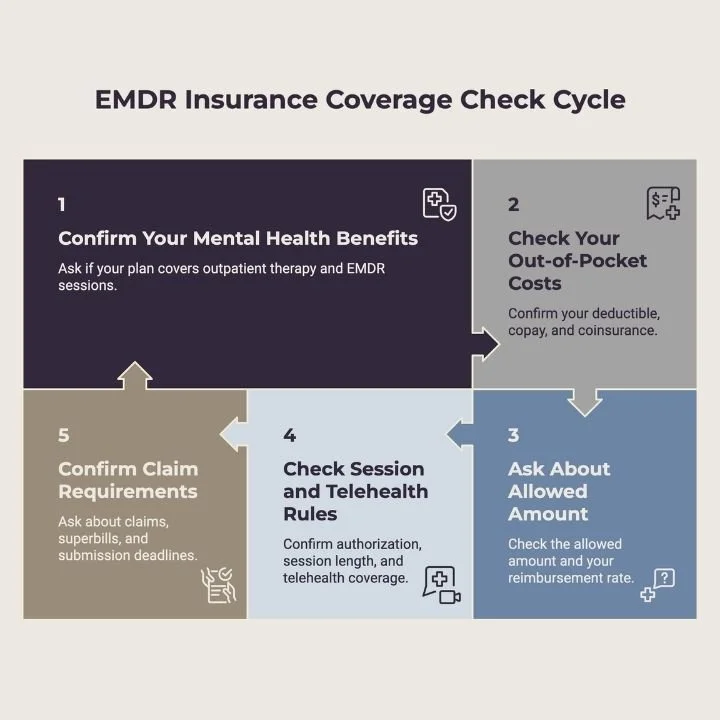
A general statement that your plan covers mental health care isn’t enough to estimate your costs. Use these five steps to check the details that apply to your treatment.
1. Confirm your outpatient mental health benefits
Call the number on your insurance card and ask whether your plan covers outpatient psychotherapy, including sessions that use EMDR. Check benefits for both in-network and out-of-network therapists, and ask whether your chosen therapist’s license type qualifies for coverage.
2. Check your deductible, coinsurance, and copay
Your deductible is the amount you pay for certain covered services before your plan starts paying. A copay is a fixed amount for a covered service, while coinsurance is your percentage of the allowed cost.
Ask which costs apply to outpatient psychotherapy and how much remains on your deductible for the current plan year. If you’re using an out-of-network therapist, check whether there’s a separate out-of-network deductible.
3. Ask how your plan calculates the allowed amount
The allowed amount is the maximum amount your plan recognizes for a covered service. For out-of-network therapy, reimbursement may be calculated using this amount rather than the therapist’s full fee. You may be responsible for the difference.
Ask your therapist for the expected psychotherapy billing code, session length, and provider details. Give this information to your insurer and ask for the allowed amount and reimbursement percentage.
For example, if a session costs $250, the allowed amount is $150, and your plan reimburses 60% of that amount after your deductible is met, you would receive $90 back and pay $160 yourself. This is a hypothetical example, not a quote for this practice or a guarantee of payment.
4. Verify authorization, session length, and telehealth rules
Ask whether outpatient psychotherapy requires prior authorization or a referral and whether the planned session length is covered. For virtual EMDR, check telehealth benefits, provider eligibility, and any location requirements.
Don’t assume that in-person and virtual sessions have identical coverage rules.
5. Confirm the claim and superbill requirements
For out-of-network therapy, ask how to submit a claim, what documentation your insurer requires, and whether there’s a submission deadline. Check what information must appear on your therapist’s superbill, such as service dates, billing codes, diagnosis codes, and provider details.
A superbill is an itemized document used to support an insurance claim. It does not guarantee reimbursement. Keep your insurer’s written response or the reference number from your call; a benefits estimate is still subject to claim review.
How out-of-network reimbursement works at CBT / EMDR Therapy of Manhattan

CBT / EMDR Therapy of Manhattan does not participate in insurance networks. Here’s how payment and reimbursement work at the practice.
You pay the full session fee upfront
Clients pay the full fee for each session. Ask about the current fee and expected session length before starting treatment so you can compare those details with your insurance benefits.
Thomas Whitfield provides a monthly superbill
At the end of each month, Thomas Whitfield can provide an invoice, also known as a superbill, for you to submit to your insurance company. The practice can also submit an insurance claim on your behalf.
Your insurer determines the reimbursable amount
If your plan includes out-of-network benefits, you may receive a portion of your payment back. Your insurer determines eligibility and reimbursement based on your benefits, deductible, allowed amount, and claim details.
Confirm your coverage before scheduling EMDR therapy in New York City
Checking benefits before treatment can help you plan for the upfront fee and possible reimbursement. You don’t have to sort out the practice’s billing process alone; bring your questions to your consultation.
CBT / EMDR Therapy of Manhattan offers in-person sessions at 330 West 58th Street, Suite 307, and virtual care across New York.
Schedule your free consultation or call (917) 935-4040 to get started.
Questions about EMDR costs and insurance coverage
How much does EMDR therapy usually cost in New York City?
There’s no single rate for EMDR therapy in New York City. Fees vary by therapist, session length, and practice. Ask for the current session fee and compare it with your expected reimbursement to estimate your out-of-pocket cost. At CBT / EMDR Therapy of Manhattan, contact the practice for current fees.
Is EMDR therapy covered by Medicare?
Medicare Part B covers outpatient psychotherapy when its coverage and provider requirements are met. An EMDR session may qualify as covered psychotherapy, but the treatment name alone does not establish coverage. Check the therapist’s Medicare enrollment or opt-out status. Medicare generally does not pay for services from providers who have opted out. If you have Medicare Advantage, also check your plan’s network and authorization requirements.
Can insurance cover virtual EMDR therapy?
Yes, some plans cover psychotherapy delivered through telehealth, which may include EMDR. Ask whether your policy covers the planned virtual sessions and whether the therapist meets your insurer’s requirements.
Can you receive EMDR therapy for free?
Free EMDR therapy is not guaranteed. Lower-cost mental health care may be available through Medicaid-covered providers, community health centers, nonprofit programs, training clinics, or therapists with sliding-scale fees. Community health centers offer sliding-scale fees. Ask whether a program offers EMDR and what you would pay; reduced-cost care does not necessarily mean free EMDR.
Does insurance require a PTSD diagnosis to cover EMDR?
Not necessarily. Coverage depends on your plan’s medical necessity criteria, the diagnosis being treated, the psychotherapy service, and provider eligibility. Ask your insurer about the applicable criteria. Your therapist determines the diagnosis through a clinical assessment.