
Complex Trauma vs. PTSD: How Can You Tell the Difference?
Complex trauma describes repeated or prolonged traumatic experiences and their lasting effects, while post-traumatic stress disorder (PTSD) is a diagnosable mental health condition that can develop after trauma. Complex PTSD (C-PTSD) is a distinct diagnosis in the International Classification of Diseases, 11th Revision (ICD-11), that includes PTSD symptoms plus persistent difficulties with emotions, self-concept, and relationships.
Someone can experience complex trauma without developing PTSD or C-PTSD, and the type of trauma alone doesn’t determine the diagnosis. Recognizing the difference can help you make sense of persistent symptoms and explore trauma therapy in Manhattan based on your needs.
Complex trauma, PTSD, and C-PTSD at a glance
Complex trauma describes experiences and their effects; PTSD and C-PTSD describe specific symptom patterns. Here’s a quick comparison:
| Characteristic | Complex trauma | PTSD | C-PTSD |
|---|---|---|---|
| What it is | Repeated or prolonged trauma and its lasting effects | A trauma-related mental health condition | PTSD plus persistent difficulties with emotions, self-perception, and relationships |
| Trauma pattern | Usually repeated, prolonged, or interpersonal | Can follow single or repeated trauma | Often linked to repeated or prolonged trauma, but not required |
| Core symptoms (ICD-11 for PTSD and C-PTSD) | Effects can involve emotions, self-image, trust, and relationships | Re-experiencing in the present, avoidance, and a heightened sense of current threat | PTSD symptoms plus persistent difficulties with emotional regulation, self-perception, and relationships |
| Emotional regulation | Overwhelm, numbness, or reactivity may develop | Emotional distress and reactivity can occur | Persistent difficulty regulating emotions |
| Self-perception | Shame or negative self-beliefs may develop | Negative trauma-related beliefs can occur | Persistent feelings of worthlessness, defeat, or shame |
| Relationships | Trust and connection may be affected | Detachment or avoidance can affect relationships | Persistent difficulty feeling close or connected to others |
| Diagnosis | Not a diagnosis | Recognized diagnosis | Recognized in ICD-11, but not as a separate DSM-5-TR diagnosis |
The comparison uses ICD-11’s core PTSD symptom groups to explain how PTSD and C-PTSD differ. The Diagnostic and Statistical Manual of Mental Disorders (DSM-5-TR), commonly used in the United States, defines PTSD more broadly and does not classify C-PTSD as a separate diagnosis.
In contrast, ICD-11 recognizes C-PTSD as a distinct diagnosis, as explained by the National Center for PTSD. Under ICD-11, a clinician diagnoses PTSD or C-PTSD, rather than both.
How do PTSD and C-PTSD symptoms differ?
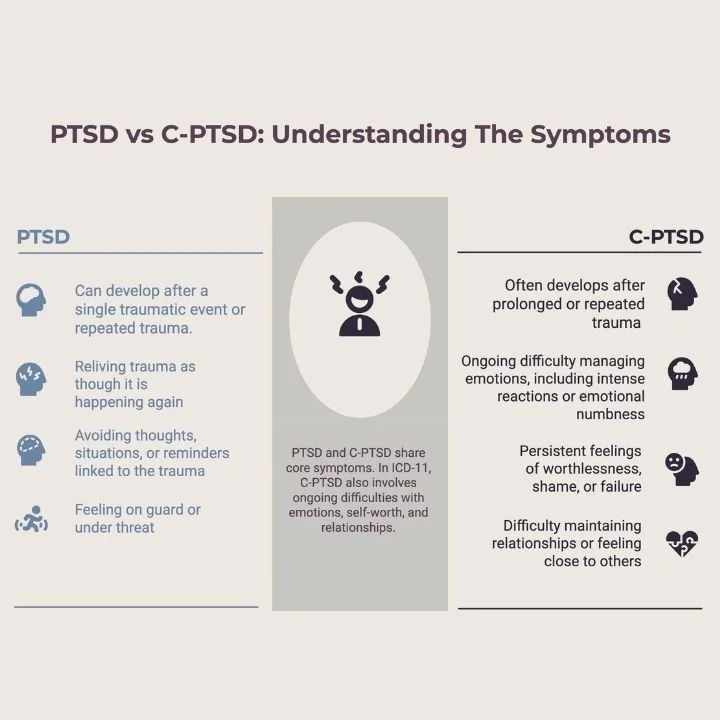
In ICD-11, PTSD and C-PTSD share core trauma symptoms, but C-PTSD involves additional difficulties known as disturbances in self-organization.
PTSD involves re-experiencing, avoidance, and heightened threat
PTSD can involve reliving a traumatic experience through intrusive memories, nightmares, or flashbacks, avoiding trauma reminders, and remaining highly alert to possible danger. In ICD-11, re-experiencing involves feeling as though the event is happening again in the present.
The DSM-5-TR criteria organize PTSD symptoms into four groups: intrusion, avoidance, negative changes in thoughts and mood, and changes in arousal and reactivity. Negative self-beliefs, emotional numbness, and relationship difficulties can therefore occur with PTSD, too.
These symptoms can interfere with relationships, work, sleep, and daily functioning, although the specific presentation varies from person to person.
C-PTSD adds persistent difficulties with emotions, self-concept, and relationships
C-PTSD can have a broader effect on how a person manages emotions, views themselves, and connects with others. This may include emotional reactivity or numbness, feelings of worthlessness or shame, and difficulty sustaining emotional closeness. An ICD-11 diagnosis requires difficulties across all three areas, alongside PTSD symptoms and significant impairment in daily life.
How are PTSD and C-PTSD diagnosed?

A diagnosis requires a clinical assessment, not just a history of repeated trauma or a symptom checklist. The clinician considers the diagnostic framework being used and other possible explanations for your symptoms.
A clinical assessment examines symptoms, history, and daily functioning
A clinician evaluates how symptoms developed, how long they’ve persisted, and how they affect everyday life. The assessment also considers other conditions that could contribute to or better explain what a person is experiencing.
An online C-PTSD test cannot confirm a diagnosis
Online screening tools can help identify symptoms worth discussing, but they can’t provide a definitive diagnosis. The International Trauma Questionnaire is a researched self-report measure for ICD-11 PTSD and C-PTSD, but its results are considered provisional.
C-PTSD can overlap with BPD, anxiety, depression, and dissociation
Some C-PTSD symptoms can resemble or occur alongside other mental health conditions, including anxiety, depression, and borderline personality disorder (BPD). Dissociation can also occur. This overlap makes differential diagnosis important, as clinicians consider the complete symptom pattern rather than relying on a single symptom or screening result.
Which evidence-based treatments address trauma symptoms?

EMDR, Cognitive Processing Therapy (CPT), and Prolonged Exposure (PE) have some of the strongest research support for PTSD. Research on treatment specifically for ICD-11 C-PTSD is still developing, and current evidence does not show that everyone with C-PTSD requires a different treatment approach.
Eye movement desensitization and reprocessing
EMDR therapy in Manhattan is a structured trauma-focused therapy that involves recalling traumatic memories while engaging in bilateral stimulation, such as guided eye movements, tapping, or auditory cues. Research supports EMDR as an effective treatment for reducing PTSD symptoms.
Trauma-focused cognitive behavioral therapies
Cognitive Processing Therapy is a trauma-focused talk therapy that helps people identify and work through unhelpful beliefs related to traumatic experiences. Other trauma-focused cognitive behavioral approaches may also help reduce trauma-related distress.
Structured exposure-based treatments
Prolonged Exposure gradually helps people approach trauma memories and safe situations they have avoided because of trauma-related distress. Through repeated, structured exposure, treatment aims to reduce avoidance and help people process trauma-related memories and emotions.
When should you consult a trauma therapist in NYC?

Consider consulting a trauma therapist when intrusive memories, avoidance, hypervigilance, emotional distress, sleep problems, or relationship difficulties persist and interfere with daily life. You don’t need to figure out the right diagnosis on your own before seeking support.
An evidence-based trauma therapist can treatment in NYC can help you understand your symptoms, compare evidence-based treatment options, and decide where to begin.
Discuss your symptoms with a trauma-informed therapist
A professional assessment can help clarify what you’re experiencing and identify treatment options supported by research. You can start by talking about what’s been difficult, even if you’re unsure how to describe it.
CBT / EMDR Therapy of Manhattan provides evidence-based trauma treatment in NYC, with in-person therapy in Manhattan and virtual therapy across New York. Schedule your free consultation or call (917) 935-4040 to discuss your next steps.
Questions about complex trauma, PTSD, and C-PTSD
Is there an official list of 17 C-PTSD symptoms?
No. There is no official ICD-11 list of 17 C-PTSD symptoms. ICD-11 defines C-PTSD through core PTSD symptoms plus disturbances in emotional regulation, self-concept, and relationships. Lists of “17 symptoms” found online may combine symptoms from different frameworks rather than represent official diagnostic criteria.
What does a C-PTSD trigger feel like?
A trauma reminder can bring intense emotional or physical reactions, intrusive memories, heightened alertness, or an urge to avoid or escape. Experiences vary between people, and having a strong reaction to a reminder does not by itself establish a C-PTSD diagnosis.
Is C-PTSD more serious than PTSD?
C-PTSD is not simply a more serious version of PTSD. Under ICD-11, it includes PTSD symptoms plus difficulties with emotional regulation, self-concept, and relationships. Research has associated C-PTSD with greater functional impairment in some samples, but severity varies considerably between individuals.
What physical symptoms can occur with C-PTSD?
Trauma-related distress can occur alongside sleep disruption, muscle tension, fatigue, a racing heartbeat, sweating, gastrointestinal discomfort, or heightened startle responses. Physical symptoms are not specific to C-PTSD, so new or concerning symptoms should not automatically be attributed to trauma.
Does C-PTSD ever fully go away?
C-PTSD symptoms can improve with appropriate treatment, but there is no universal timeline or guaranteed outcome. Current research indicates that established trauma-focused PTSD treatments can also help people with C-PTSD, while researchers continue studying which additional or phased approaches may provide added benefit.