
How EMDR Changes the Brain and Helps Reprocess Trauma
EMDR appears to change how the brain responds to traumatic memories while leaving the memories intact. Recalling a distressing memory while attending to eye movements or other bilateral stimulation may reduce the memory’s vividness and emotional intensity. Researchers haven’t confirmed one mechanism that fully explains how EMDR changes the brain.
People exploring EMDR therapy in Midtown Manhattan often want a clear explanation of what “reprocessing” means. EMDR is a guideline-supported treatment for PTSD, yet claims that it permanently rewires a specific brain region, moves memories to a new location, or equally activates both brain hemispheres go beyond current evidence. Here’s what research can and can’t tell us.
Why traumatic memories can keep feeling present

Traumatic memories can feel current when reminders activate the emotions, beliefs, and physical responses associated with the original experience. This reaction is especially relevant to PTSD, although people respond to trauma in different ways, and not every distressing memory produces the same symptoms.
Threat responses can remain easy to activate
A sound, smell, place, conversation, or physical sensation associated with a traumatic event can trigger an alarm response after the danger has passed. The reaction may begin quickly, before you have fully identified the reminder or recognized that you’re safe in the present.
Memories can feel disconnected from time and context
Intrusive memories and flashbacks may include images, sounds, emotions, or body sensations that carry a strong sense of present threat. Even when a person knows the event happened in the past, the emotional and physical response can still feel immediate.
Thoughts, emotions, and body sensations stay connected
A traumatic memory may be linked with fear, shame, helplessness, tension, nausea, a racing heart, or a belief such as “I’m not safe.” Recalling one part of the experience can activate several of these responses together. EMDR addresses the memory along with the thoughts, emotions, and physical sensations connected to it.
How EMDR may change memory processing in the brain
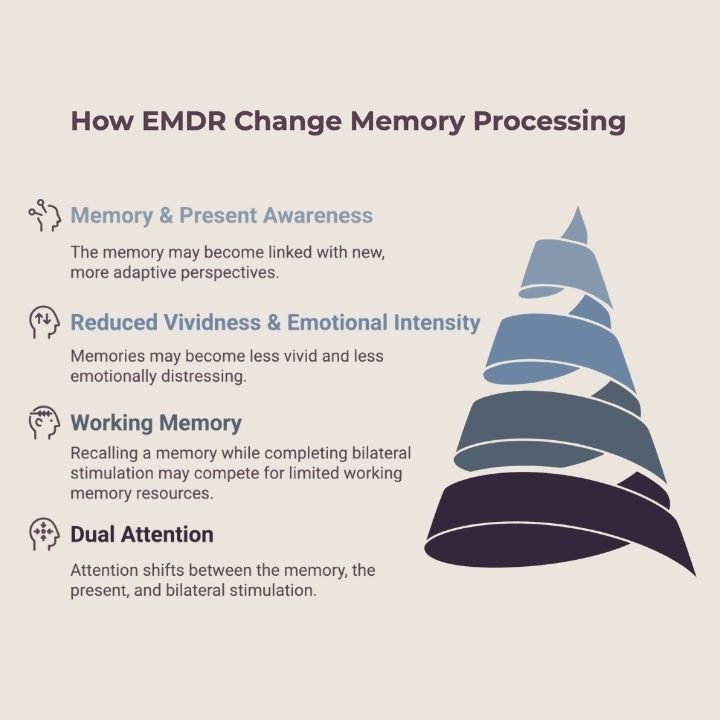
EMDR is a structured psychotherapy that involves much more than eye movements. During reprocessing, the client briefly recalls a target memory while attending to bilateral stimulation, such as guided eye movements, alternating taps, or tones. Researchers have proposed several overlapping explanations for the changes that may follow.
Attention moves between the memory and the present
EMDR uses dual attention: one part of your attention is directed toward the distressing memory, while another attends to bilateral stimulation and the therapist’s prompts. Processing occurs in short sets, with pauses to notice what has changed and remain oriented to the present.
Eye movements may place demands on working memory
Working memory is the limited-capacity system used to hold and work with information temporarily. Recalling a vivid memory and completing a second task at the same time may create competition for those limited resources.
A recent systematic review of 11 studies found that dual-task conditions generally reduced the vividness and emotional intensity of distressing memories compared with recall alone. Only two included studies used follow-up testing, however, and those effects didn’t appear to last. The review supports working memory as a plausible mechanism. It doesn’t prove that working memory explains the full clinical effect of EMDR.
Vividness and emotional intensity can decrease
During successful treatment, a memory may become less upsetting or less absorbing when recalled. The event remains part of the person’s history and may still carry meaning. Clinical value comes from reduced distress and better functioning, and clear recall may remain.
Reprocessing may connect the memory with updated information
EMDR can help a person consider information that wasn’t emotionally accessible during the original event, such as “I survived,” “I have choices now,” or “It wasn’t my fault.” The memory remains part of the person’s history. Its connection to present danger and negative self-beliefs may weaken.
Researchers often describe this change as integration or updated memory processing. Those terms describe theoretical models. Researchers cannot directly observe a memory being moved or rewritten in the brain.
What neuroscience can and cannot confirm about EMDR

Research supports EMDR’s effectiveness for PTSD more clearly than it explains the therapy’s mechanism. The U.S. Department of Veterans Affairs describes EMDR as a recommended trauma-focused psychotherapy for PTSD while noting continued debate about how bilateral stimulation contributes to treatment.
Working memory is one leading explanation
Working memory theory offers a credible explanation for reductions in vividness and emotional intensity during dual-task recall. Other proposed processes include changes in arousal, attention, fear extinction, and access to new associations. These explanations may overlap. No single theory has been confirmed as the complete answer.
Brain-imaging findings remain preliminary
A 2019 fMRI study enrolled 36 adults with PTSD and assigned them to EMDR or a wait-list condition with supportive therapy. After treatment, the EMDR group showed changes in brain activity and connectivity during a fear-extinction task, including changes involving the amygdala and left hippocampus.
The study was small, examined a specific task, and hasn’t established a universal brain signature for EMDR. Brain-imaging findings can generate useful hypotheses. They can’t yet show exactly how EMDR produces improvement in an individual client.
EMDR does not erase memories or verify their accuracy
EMDR aims to reduce the distress associated with a memory while preserving the person’s awareness of the event. Historical accuracy cannot be established through treatment, and every remembered detail may not be accurate. Care should center on current distress and functioning. Recovering or validating missing memories falls outside EMDR’s purpose.
What successful reprocessing may feel like

Changes in symptoms, distress, beliefs, and daily functioning provide meaningful measures of successful reprocessing. A brain scan isn’t used to determine treatment success. The experience varies, and several changes are common treatment goals.
Triggers may feel less immediate
Reminders may produce less fear, panic, shame, or overwhelm. Triggers can still occur. They may feel more manageable and become less likely to disrupt work, sleep, relationships, or daily routines.
The memory may feel more firmly in the past
You may be able to recall what happened without feeling pulled back into the experience. The event remains part of your history and may feel less like a threat unfolding in the present.
Body reactions may settle and negative beliefs may weaken
Physical reactions, such as tension, a racing heart, or nausea, may become less intense. Negative beliefs like “I’m powerless” or “It was my fault” may also shift toward more balanced beliefs that fit your current circumstances.
Schedule a free EMDR consultation in New York
Understanding how EMDR changes the brain can make the process feel less mysterious. Treatment decisions should be based on your symptoms, history, goals, and readiness. Specific brain changes cannot be promised.
CBT EMDR Therapy of Manhattan provides in-person EMDR therapy at 330 W 58th St, Suite 307, in New York City, and online therapy across New York. Schedule a free EMDR consultation to discuss your concerns and learn if this approach may fit your treatment goals.
Common questions about EMDR and the brain
What kind of trauma does EMDR help?
EMDR has its strongest research support for PTSD following traumatic experiences, including assault, abuse, accidents, combat, disasters, and medical emergencies. Your symptoms, history, and treatment goals determine clinical fit alongside the type of event.
Does EMDR work if you don’t remember the trauma?
EMDR may still be appropriate without a complete trauma memory. Treatment can target memory fragments, images, emotions, beliefs, body sensations, or current triggers. Missing memories cannot be reliably recovered or confirmed through EMDR.
How many EMDR sessions are needed?
There is no standard number of EMDR sessions. Treatment length depends on your symptoms, history, preparation needs, goals, and response to therapy. Your therapist should assess progress and adjust the plan as treatment continues.
How do I know if EMDR is working?
Reduced symptoms and improved daily functioning are the clearest signs that EMDR is working. Triggers may feel less intense, intrusive reactions may decrease, physical responses may settle, and difficult memories may become easier to recall.
When is EMDR not a good idea?
EMDR may need to be postponed during an immediate safety crisis, severe destabilization, or difficulty staying oriented to the present. A qualified clinician should assess readiness and recommend preparation, stabilization, urgent support, or another treatment when needed.