
Yes, EMDR for childhood trauma can help adults even decades after the harm occurred. Research supports its use for posttraumatic stress disorder (PTSD) following childhood abuse. The passage of time doesn’t mean it’s too late to seek treatment.
Past experiences may still affect sleep, relationships, or reactions to conflict, even when your circumstances have changed. Eye movement desensitization and reprocessing (EMDR) therapy aims to reduce that distress.
A treatment plan connects current reactions with selected memories and tracks changes in daily life.
What research says about EMDR for adults with childhood trauma

Research on EMDR for adults with childhood trauma supports its use for PTSD following childhood abuse. These findings don’t establish that it treats every lasting effect of childhood adversity.
A 2018 systematic review analyzed six randomized trials with 251 children and adults who had experienced complex childhood trauma. It found that EMDR reduced PTSD symptoms, and a few trials also reported gains in depression or anxiety. The authors noted small samples and differences between studies, which limit the strength of the conclusions.
A 2021 randomized trial studied 121 adults with PTSD following childhood abuse. It compared EMDR alone with skills training followed by EMDR. Both groups improved, with no significant difference in PTSD outcomes between groups.
Your therapist still needs to assess your current symptoms, circumstances, and treatment needs before recommending it.
How EMDR therapists choose where to start after repeated childhood trauma
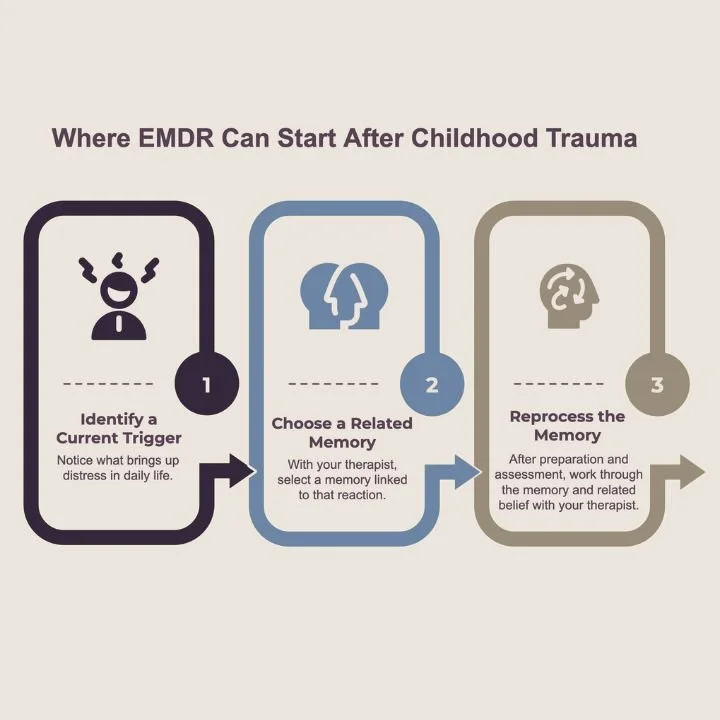
In EMDR for childhood trauma, treatment planning considers current symptoms, past experiences, and available support. The example below follows a present-day trigger to a related childhood memory; your therapist may start elsewhere.
1. Identify a present-day trigger
Your therapist may ask about a recent situation and how you responded. A supervisor’s raised voice might leave you shaking, unable to speak, or expecting punishment. Examining the thoughts, emotions, physical sensations, and actions that follow helps identify the reaction needing attention.
Your therapist also checks current safety. If a workplace is threatening, treatment needs to address that situation rather than attributing all distress to childhood.
2. Choose one memory linked to that trigger
You and your therapist may select one memory connected to the reaction. A childhood incident involving shouting might become the focus of targeted work.
Your therapist assesses your distress when recalling the memory and your ability to stay connected to the present while also considering your history, current safety, and treatment preferences. Assessment then identifies an associated image, belief, emotion, and body sensation, along with ratings that serve as a baseline.
3. Reprocess the memory and revisit the belief it brings up
Reprocessing begins after preparation and assessment. You focus on the selected memory while following guided eye movements, taps, or sounds. Between short sets, you report changes in thoughts, images, emotions, or body sensations, and those reports guide the next steps.
A belief such as “I am powerless” can lose some force as you connect the childhood memory with choices available now. Later phases strengthen a preferred belief and check for remaining physical distress.
The VA’s guide to EMDR for PTSD explains that processing can make traumatic memories feel less distressing and help develop more positive beliefs. EMDR can change how these memories affect you without erasing what happened.
When a therapist may slow down EMDR

Memory work can slow or pause when distress becomes hard to manage, when you struggle to stay present, or when current safety concerns need attention. The pace depends on your symptoms, safety, history, and response to treatment, rather than a fixed schedule.
Feeling detached from yourself, losing track of time, or feeling disconnected from your surroundings can signal dissociation. Report these experiences during or between appointments. Your therapist may shorten memory work, add preparation, or refer you to a clinician with additional training.
When choosing an EMDR therapist, ask how they assess readiness and respond to overwhelm. You should know how to request a pause, what support is available between visits, and how the treatment plan changes if symptoms worsen.
How to tell if EMDR is helping in daily life

Track changes in your usual routines across appointments, using examples like these:
- Less avoidance: You attend a meeting or appointment you previously skipped.
- Faster recovery: A difficult conversation affects you for less time.
- Reduced self-blame: The belief that you caused the abuse feels less convincing.
- Better daily functioning: Sleep, concentration, work, or relationships become easier to manage.
Review these changes alongside symptom questionnaires and session ratings. Progress can mean returning to an activity while some anxiety remains. Report worsening sleep, more withdrawal, or distress that repeatedly disrupts your day, since those changes call for a plan review.
Schedule a free trauma therapy consultation in Manhattan
Bring one recent example of a reaction you want to address, such as disrupted sleep, withdrawal after conflict, or avoiding an ordinary activity. Ask how treatment would approach that pattern.
CBT / EMDR Therapy of Manhattan offers therapy for childhood trauma in adults, in person near Columbus Circle and online across New York. Schedule your free consultation to ask about treatment options, therapist availability, and beginning care.
FAQs about EMDR for childhood trauma
Can EMDR help if you only remember parts of your childhood?
EMDR may still be an option when childhood memories are incomplete. You don’t need to recall every detail or put past events into a complete story for therapy to proceed. EMDR can’t verify that images or memories emerging during treatment are historically accurate.
How much detail do you have to share during EMDR?
You don’t have to describe every disturbing detail aloud. Your therapist needs enough information to assess your concerns, plan treatment, and understand your responses. Explain when sharing feels difficult and ask which information is needed. During reprocessing, you report changes without narrating the entire experience.
How long does EMDR treatment take?
Treatment length depends on preparation, the memories addressed, symptom changes, and session frequency. Ask your therapist when you’ll review progress and reassess the plan. Read more about factors that affect EMDR session count.
What if EMDR brings up more distress between sessions?
Follow the coping and contact plan agreed with your therapist. Describe the reactions, how long they last, and their effect on sleep or daily responsibilities. Persistent or worsening distress needs review before further memory work. Don’t assume you must tolerate it for treatment to help.
What are your options if EMDR isn’t helping?
Ask your therapist to review the treatment targets, progress, and barriers. Options may be adjusting the approach, consulting another clinician, or changing treatments. For PTSD, cognitive processing therapy and prolonged exposure are established alternatives. Ask why the proposed change fits your symptoms and preferences.